
Anywhere from 70% to 80% of professional roles are never advertised before they are filled. This figure could actually be higher in Mongolia. It is no secret. It is a common practice. And if you are a hiring manager, then it may be slowly draining away potential applicants you may never come across.
The best professionals in Mongolia are usually off the radar. Not because of any skill deficiencies, but rather because they do not belong to the correct chat groups or networking events in the city of Ulaanbaatar. They are out there somewhere, and yet the market never sees them.
The comfort of the small circle, and why it is not enough
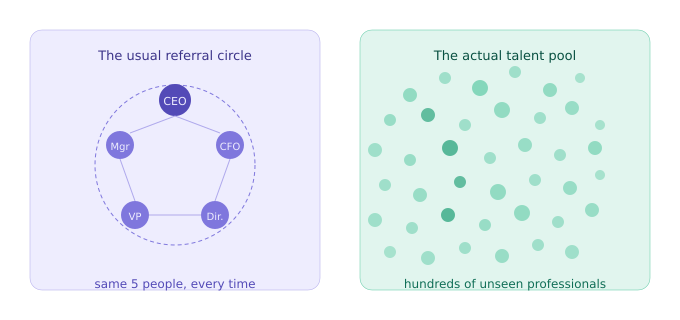
In a simple term, Mongolia’s professional network is compact. When a leadership or specialist role opens, it’s usually the same scenario for many places. They call a few people they trust and ask who they know. Those people are often already employed, known, or being chased by someone else. The pool looks busy but it is certainly shallow.
It makes total sense that this approach is prevalent and it’s not because of laziness. It came from logic. In a market where salaries are opaque and credentials can be inflated, a referral feels safe. The person vouching has a reputation in the game. That is the real value.
Unfortunately, the same small group of candidates gets approached again and again. Their salary expectations inflate and the thousands of capable people who are not in that circle stay invisible, including people in Darkhan or Erdenet city, Mongolians quietly returning from years abroad, and professionals who simply never learned how or never had the time to network in the right rooms.
The market is bigger than it feels
But the facts paint a completely different picture. For example, Mongolia boasts 2.8 million Internet users. And that is only the number of people registered on LinkedIn. This number exceeds half a million profiles belonging to residents of the country. That figure does not even take into consideration the individuals whose information needs updating, as well as those people who have never used social networking sites like LinkedIn at all.
The old way worked when the economy was simpler and everyone knew everyone. But Mongolia’s private sector is changing. Fintech, logistics, professional services, and technology are growing. They need skills that did not exist in the local market a decade ago. You cannot fill a niche compliance role or a data leadership position by asking your old classmate if he knows someone. You need to see a bigger picture.
What Lambda.Global is doing about it
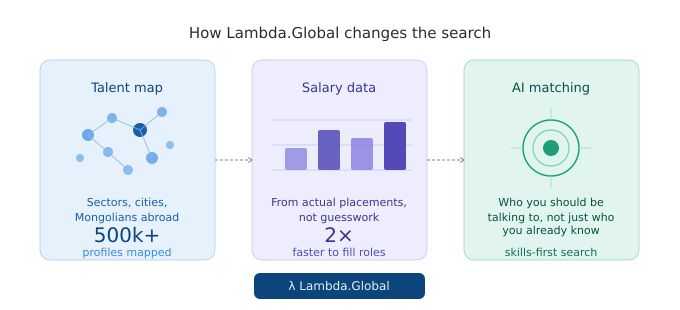
Lambda.Global was not built to be a job board. A job board lists vacancies. It does not solve the problem of who gets seen. Lambda works the other way around. It all begins with the talent pool, but with the help of data, it connects the right individuals to the right opportunities, no matter whether these two never would have met under normal circumstances. This results in three things being done differently.
Lambda.Global keeps a running map of professionals across sectors, locations, and experience levels, including Mongolians abroad who are open to working here but have no obvious way to wave their hand and say “I exist”. That alone changes a hiring conversation before it even begins.
Then there’s the money question. In a market where salary talks often collapse because nobody knows what’s real, Lambda pulls compensation data from actual placements, not from surveys that have been sitting in a drawer for two years. Therefore, both sides can show up with numbers they can defend, not numbers they pulled from nowhere. A lot of good matches die simply because someone guessed wrong. Lambda makes guessing less necessary.
And when it’s time to find the person, the platform uses AI not to judge who is best, but to pull forward candidates who actually fit. It means the search stops being about who you already know and starts being about who you should be talking to. Lambda’s own placement data backs this up. Roles that are posted with clear pay ranges and an open search scope fill about twice as fast as the ones that still run on the old model.
Another part worth paying attention to is who finally gets considered. People who would never have landed on a referral shortlist start showing up in final interviews. That’s not a minor improvement. It’s a different hiring market entirely.
Let’s take an example where a Mongolian manufacturing firm needed a lead role. The role had been empty for several months. The CEO had exhausted every contact he had, but someone on his team suggested Lambda. Within a few weeks, the platform surfaced a candidate the CEO had never heard of. The candidate was not in any chat group and he was not on anyone’s referral list. He took the job. This is not technology saving the day. It is seeing what was already there. The talent did not appear because Lambda created it. It appeared because Lambda made it visible.
Moreover, Lambda.Global is not trying to kill referrals. Referrals will always matter and they should. What Lambda is doing is putting data and transparency alongside personal relationships, so the referral is not the only door. So a company can still trust its network while also growing it.
Lambda.Global gives companies a map of the talent that is actually out there, not just the talent that happens to be in the same group. Mongolia’s hiring problem is not a shortage of capable people. It is a habit of looking in the same small places and pretending that is the whole market. Breaking that habit does not require a revolution. It requires a decision that can be made tomorrow morning.
References
- Internet penetration: Mongolia has approx. 2.8 million internet users (DataReportal, Digital 2025 Mongolia).
- LinkedIn profiles in Mongolia: over 550,000 active professionals
- Lambda.Global internal placement data (2025–2026)
- World Bank, Skills demand in Mongolia: Main Findings of the Skills Module of the Barometer Survey (2022)