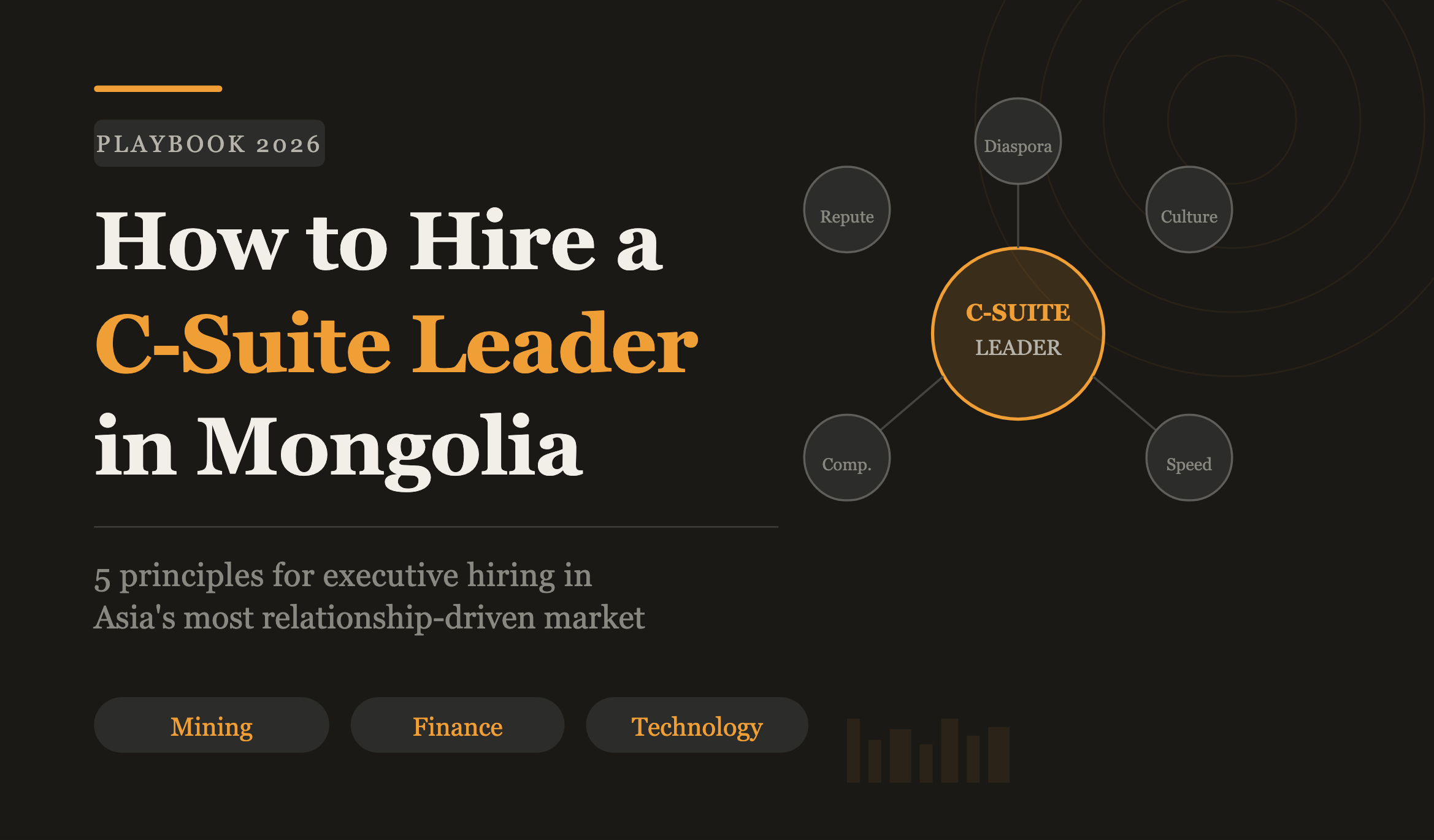
Mongolia’s executive talent market is exceptionally small compared to most Asian economies. In 2026, hiring proven C-suite leadership has become even more difficult as competition for experienced executives intensifies across mining, finance, technology, and infrastructure sectors.
At the same time, Mongolia’s new Minerals Law overhaul and the introduction of a 20% tax bracket for high earners are reshaping how executives evaluate career opportunities, compensation, and long-term stability. The gap between a “good” executive and a truly strategic, compliant, and internationally capable leader has never been wider.
If your company is still hiring executives based on resumes alone, you are already behind the market.
In this playbook, we break down the five most important hiring principles for identifying, attracting, evaluating, and retaining top-tier executive talent in one of Asia’s most relationship-driven and competitive hiring markets.
- Returning Diaspora Talent
In 2026, the most valuable C-Suite candidates are often those returning from abroad. The government’s “Year of Employment Support” has accelerated the return of high-skilled Mongolians from hubs like London, Seattle, and Seoul. It makes them the top participants because these candidates offer a rare “dual-fluency”—they understand global corporate governance yet possess the local cultural intuition needed to navigate Ulaanbaatar’s business circles.
When hiring them, don’t just search locally. Use search filters to map the Mongolian diaspora. Currently, you can find them on lambda.global diaspora page.
2. Leadership Reputation Matters More Than the Resume
In Mongolia’s executive market, reputation travels faster than CVs. A candidate may have impressive titles on paper, but their actual leadership style, industry relationships, and decision-making history matter far more.
When evaluating executive talent, companies need to look far beyond a polished resume. A candidate’s reputation within the industry, ability to retain and lead teams, crisis management experience, and relationships with regulators, investors, and key stakeholders all play a critical role in long-term success. It is equally important to assess their ethical standards and compliance history to minimize potential operational or reputational risks. At the executive level, a single poor hiring decision can negatively impact company culture, weaken investor trust, and slow business growth for years.
3. Cultural and Political Intelligence Is Critical
Being technically skilled is not enough for someone to succeed as a senior executive in a country like Mongolia. Strong leaders also need to understand how Mongolia’s business environment works in real life. This includes understanding local business culture, government regulations, and how relationships influence important decisions. Executives must know how to communicate with employees, investors, regulators, and other stakeholders while managing different personalities and expectations inside the company.
Cross-cultural communication is also becoming more important as more international companies enter the Mongolian market. A leader who performed successfully in cities like Singapore, Seoul, or London may still struggle in Mongolia if they cannot adapt to the country’s unique business culture, leadership expectations, and fast-changing economic environment.
4. Compensation Is No Longer Just About Salary
Executive candidates in 2026 are evaluating opportunities more strategically than before. While compensation remains important, many leaders now prioritize decision-making authority, organizational stability, governance quality, international exposure, and long-term career growth. Mongolia’s introduction of higher tax brackets for high earners, combined with rising competition for leadership talent, has also changed how executives evaluate total compensation packages.
Global workforce studies show that executives increasingly care about flexibility, organizational trust, and long-term value creation rather than salary alone. Companies offering equity, performance incentives, strong governance structures, and meaningful leadership opportunities are becoming more competitive in attracting high-level talent.
5. Speed and Clarity Win Executive Talent
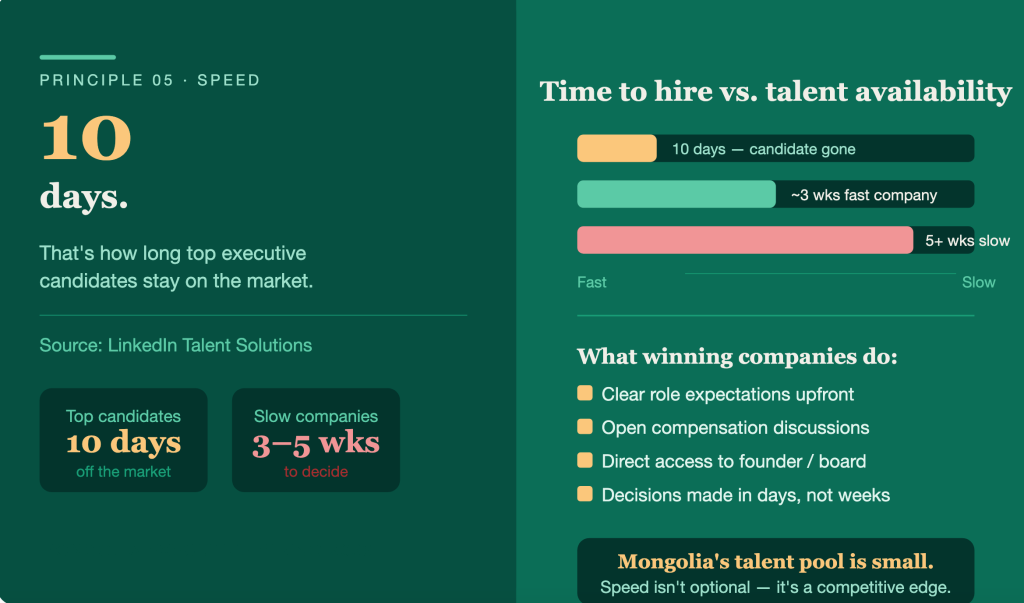
Research from global recruitment firms shows that long hiring processes are one of the biggest reasons companies lose high-level talent. According to executive hiring studies by LinkedIn Talent Solutions, top candidates are often off the market within 10 days, while many companies still take several weeks to make decisions. In Mongolia’s smaller executive ecosystem, this challenge becomes even more severe because the pool of experienced leadership talent is already limited.
Senior executives are usually involved in multiple confidential discussions at the same time, especially in industries such as mining, banking, technology, and infrastructure. Delayed interview scheduling, unclear reporting structures, or inconsistent communication can quickly damage a company’s credibility during the hiring process.
Successful companies usually stand out by maintaining a professional and transparent hiring process. This includes providing clear role expectations, having open compensation discussions, making decisions quickly, and ensuring direct communication with founders or board members. Strong onboarding and leadership support also help companies build trust with executive candidates and improve long-term retention.
Key Takeaways
- Mongolia’s executive talent market is small, competitive, and relationship-driven.
- Strong executive hiring requires more than reviewing resumes alone.
- Returning diaspora professionals are becoming valuable leadership candidates in 2026.
- Cultural intelligence and stakeholder management are critical for executive success in Mongolia.
- Today’s executives prioritize stability, influence, and governance alongside compensation.
- Fast, transparent hiring processes help companies secure top-tier talent before competitors do.
REFERENCES
Linkedin: Mongolia’s Labor Market: Key Insights from our “HR 2026” Report
Mercer: Global Talent Trends 2026. Solving the human–machine equation
Higher.Careers: Mongolian Job Market