

Bilguun left for Singapore in 2014. He was 24 when he left and he had a finance degree from a university in Ulaanbaatar city that nobody outside Mongolia had heard of. For seven years he climbed in a foreign land. He began working with a local bank, followed by a startup, and ended up doing business across three countries. By 2023, he was earning what those back home that he grew up with would only earn in ten years.
In a surprising turn of events, he moved back to Mongolia last November. Not for family, not because he got pushed out. He moved back because a Mongolian company offered him something that surprised even him. Not a fancy title, not a company car, not a salary that matched Singapore dollar for dollar. None of that was on the table when he got the offer. What they offered was a real authority where he could rebuild a broken finance function however he saw fit. The CEO told him “You’ll have my ear and my backing. The rest is yours.” He took the job before they even finished negotiating the bonus salary.
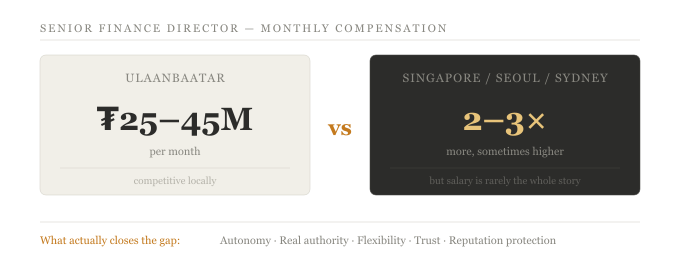
I am telling this story because it says something about Mongolia’s job market that most compensation surveys miss. We still have a gap between what executives earn in Mongolia and what their equivalent roles pay in Singapore, Australia, or Korea. Let’s say a senior finance director in UB will bring home 25 to 45 million tugriks a month. Their counterpart in a foreign country makes two or three times that, sometimes more. Money is always part of the conversation. But it’s rarely the whole conversation.
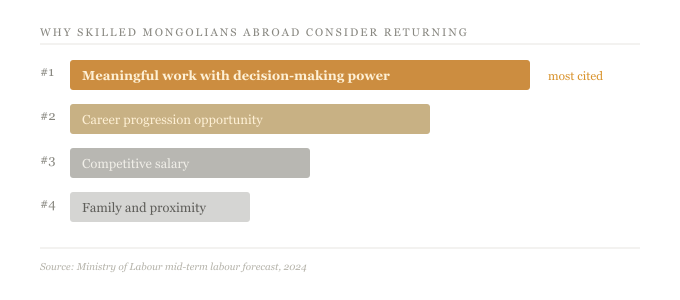
The Ministry of Labour’s own mid-term labour forecast from 2024 showed something interesting. Within highly skilled Mongolians abroad, the top reason for considering a return to Mongolia was not a competitive salary, but a meaningful work with decision-making power. According to the info, salary came third on the list after career progression. When I first read that, it felt counterintuitive to me. But then I thought about Bilguun and it started making sense.
What changes when someone reaches the senior level
Early-career employees need money. They have student loans, young families, rent, etc. But by the time someone is being recruited for a director-level role or above, the arithmetic changes. What keeps them up at night is not the difference between a 20 million and a 25 million tugrik package. It’s the fear of being positioned in a role where they have the title but not the tools. They may spend six months fighting approvals, waiting for decisions that never come, and end up watching their credibility fade because nobody empowered them to actually lead.
In a small professional market like this city, that reputation damage is permanent. Word gets around. A story about a senior hire who gets hired with fanfare and leaves quietly six months later because they couldn’t get anything done will keep following them. So experienced professionals ask harder questions in interviews. They are required to know who controls budget, who hires their team, whether the board actually wants change or just wants to announce it for the day. Companies that cannot answer those questions clearly lose the candidate.
What the data quietly shows
According to a skills survey carried out by the World Bank in 2022, Mongolian employers consider soft skills such as reliability and communication to be more crucial than technical skills. However, the same applies when senior professionals are picking their employers, based on factors like vision and leadership.
And then there’s the flexibility piece. More than 70 percent of Gen Z and Millennial professionals globally say they value flexibility over a small salary bump. In Mongolia, that number is harder to pin down with precision, but anyone who spends time talking to candidates in the 30-45 age bracket will hear a version of it. They don’t want to be chained to a desk in Central Tower for appearance’s sake. They want to work where the work happens and be judged by output, not attendance. That mindset shift is already here. The companies ignoring it are quietly losing access to the very people they say they need most.
Where Lambda.Global fits into this
At Lambda.Global, we see this play out in near real time. The platform surfaces not just who is looking, but what they’re actually looking for. Roles that clearly articulate decision-making authority and offer genuine flexibility fill noticeably faster than roles that offer a slightly higher salary but give vague answers about their “scope”. It’s a huge difference between a role sitting open for three months versus being filled in three weeks.
The other thing the data makes plain is how much talent is simply invisible to traditional network-based hiring. A Mongolian professional who has spent eight years in Seoul or Sydney doesn’t show up at the usual Ulaanbaatar city networking drinks. They’re not in the group chats that produce the same shortlists. Lambda.Global helps companies get past their own limited Rolodex and actually see the wider pool that surrounds them. Not as a database of CVs, but as a map of who is reachable and what it would take to bring them home.
A different kind of negotiation
If you’re a company trying to hire senior talent right now, some changes are needed to be made. Not because the old one is wrong. But because candidates have already changed. Before putting a number on the table, the company should know what a person can actually do in the role. Not what they’ve done in the past. But what they’ll be allowed to do with you. If that cannot be described that with confidence, the negotiation hasn’t even started yet.
And if you’re a professional sitting abroad or sitting at home thinking about a move, please start asking those questions early. The companies worth your time will have answers. The rest will fumble and change the subject. That alone tells you everything.
Mongolia’s talent market in 2026 isn’t suffering from a lack of capable people. It’s suffering from a mismatch between what is being offered and what senior professionals actually want. The gap is not about money first. It’s about trust, autonomy, and respect. The organizations that understand this are not only hiring faster. They’re building teams that stay.
A big salary might open the door. But clarity about the job is what gets someone to walk through it.

References
- Ministry of Labour and Social Protection / Research Institute of Labour and Social Protection, Labor Market of Mongolia: Mid-Term Demand and Supply Forecasting Study Report (2024) – diaspora return motivations.
- World Bank, Skills demand in Mongolia: Main Findings of the Skills Module of the Barometer Survey (2022) – employer rankings of soft vs. technical skills.
- Lambda.Global internal hiring platform insights (2025–2026) – observed time-to-fill patterns for roles with vs. without clearly defined authority and flexibility.
- General background, Youth Employment Forum highlights, Unread / ADB / Ministry of Labour and Social Protection (2025) – generational preference for flexibility.