I remember there were a podcast called “Where are the Mongolian men?” hosted by three men. Three hosts worked in a corporate sector. They have claimed that everywhere they go, in the office, restaurants, networking events, different clubs and training, there were always women outnumbering the men. Hence, they have started a podcast to discuss this issue.
According to the study the state is one of the major employers in Mongolia, especially in the rural provinces. One out of five people in Mongolia are employed by the state. Head of the government agencies are dominated by men.
There are around 120 state owned enterprises, if the subsidiary and local government owned enterprises will be added this number will rocket to 450. Men are dominantly working in these state-owned enterprises. It is not a secret that recruiting process of ministries, government agencies and state-owned enterprises are very different than the private enterprises. Private enterprises have largely merit based recruiting system. Candidates have to pass the interview and exam to get into the big company, whereas in the state-owned enterprise connection is more important than the candidates’ education and skills. This connection-based system allows a number of incompetent workforces to easily get a job.
Majority of Mongolian men are heavily interested in politics. Therefore, most of them see state enterprises as a ladder to the political leadership role. It is public knowledge that the heads of the state-owned enterprises are appointed by a political party.
The rest, who are not aspiring to the political leadership role, stays in the organization even if they dislike the job. The main reason is they are aware that, if they lose this job, they will face hard time to get another one as they have poor skills and qualifications.
For both government agencies and corporate sector, in the office environment men are either at the top or the bottom. Middle positions are dominated by women. That’s why women seem to be everywhere in the corporate world.
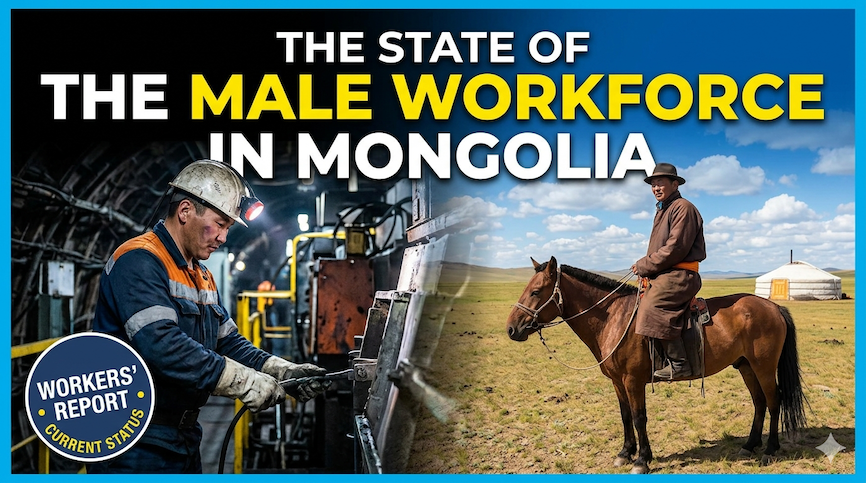
Educated and skilled Mongolian men are predominantly working in construction, mining and energy sectors in the home country. Rest is the business owners. If we look into the number of medical professionals of Mongolia, men comprise only around 20%, which is a huge gap.
Men, who have no connection to government agencies and state-owned enterprises among others, choose to go abroad and work there. Working abroad allows men to earn a decent salary to build their life. Today approximately 55,000 Mongolians are residing in South Korea, from which 37,000 are contracted workers. It is the number one destination for Mongolians. Consequently, South Korea is the largest country with bilateral social security agreement with Mongolia, where Mongolians are granted an option to be covered by Mongolian social insurance. It is not clear when will the outflow to South Korea cease, as the system sending the contractor workers is well established that even the legal regulations are in favor of it.
Another group of men are the men who are continuing the Mongolian heritage, undertaking a herding work. They regarded as a workforce in the agricultural sector. Herding is a hard work. Consequently, most herder families keep the boys to help with herding, while sending the girls to go to the university. It created a so-called reverse gender gap in education.
This is the overall picture of male workforce of Mongolia. They are either directors or a contract worker, they are a business owner or a herder. There are small number of doctors, software engineers and other specialists. Thus, there is need to support the male professionals and increase the number of highly skilled workforce.
Tips to support existing male professionals:
– Involve in professional training to upgrade their qualifications
– Involve in other self-development training
– Provide clear career path
– Provide incentives aside the salary, such as transportation and communication allowances
– Provide attractive packages such as a health insurance.
References:
1. Agreement between Mongolia and the Republic of Korea on Social Security, the Ministry of Family, Labour and Social Protection, 2006
2. Employment of Mongolians in South Korea and Changes of Foreign Labor Policy of South Korea,2024
3. Gender bias in medicine: which countries have the most female doctors, the World Health Organization, 2023
4. Mongolia’s Workforce in the Public Sector is 18.4%, Inside Mongolia, 2026
5. Reports of State-owned enterprises, Agency for State Property Policy and Coordination,2023.