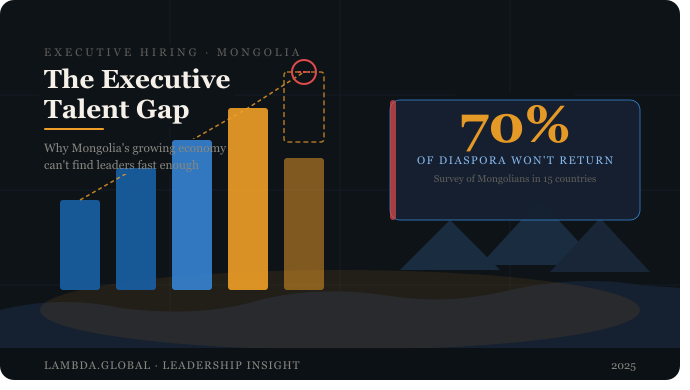
Let’s say a top-tier mining contractor in Mongolia spent close to five months trying to hire a Head of Operations. The role was critical. The salary was already above what most local companies would offer.
Candidates came and went. Some were not quite ready. Some were already tied into better roles. A few lost interest halfway through the process. In the end, the company hired someone based in Australia. The final package landed at nearly double the original budget once relocation and allowances were factored in.
No one involved would call this unusual by today’s standard. This is what executive hiring is starting to look like. And it moves slowly. In a market where even mid-level roles can take a month or two to fill, senior positions easily stretch to five or six months—sometimes longer. The search itself becomes more expensive than the salary increase companies were trying to avoid in the first place.
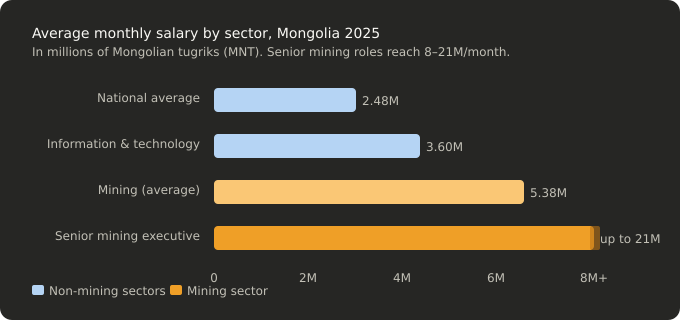
Mongolia is not short on people. It is short on people who have already seen enough to lead without hesitation. Everything might look fine if you only check the headline numbers. The national average monthly salary reached roughly 2.48 million tugriks last year. Executive base pay climbed another 8–12 percent over the same period. On paper, the market is getting stronger.
The reality is more awkward. The same handful of candidates keep circling through the same senior roles at different companies. The pool hasn’t grown. The price has. And at some point, salary stops being the main question.
Early in a career, people chase the number. That’s normal. At the executive level, the questions change. People start asking what they’re walking into. Who actually makes decisions. Whether the team is stable. Whether the business knows where it’s going. Those answers matter more than an extra one or two million tugriks. And when the answers are unclear, the offer begins to fall apart.
So, companies push harder on the one lever they can control: pay. It feels like action. It rarely fixes the real issue.
The unevenness of economic growth can be seen from many sources. Mongolia’s economy expanded by 6.9 percent in 2025 according to the World Bank. It was driven largely by mining and agriculture industries. Thanks to that growth, wages were pushed upward, especially in resource-linked industries. But higher wages are not the same as deeper capability.
Look at the spread. By late 2025, the average monthly salary in mining was about 5.38 million tugriks. In comparison, the information and technology sector had the average hovering around 3.6 million. At the top end, senior mining professionals can earn between 100 million and 250 million tugriks annually—numbers that simply don’t exist in most other industries. Mining companies aren’t being reckless; they have the margins. The problem is that this premium distorts expectations across the entire market. Banks, fintechs, professional service firms—they all end up competing against a benchmark they often cannot match, while trying to attract the same caliber of leader.
The result is a market that looks competitive but feels unstable. Compensation rises faster than the organizational maturity needed to make these roles stick.
The diaspora is not the problem. It is the signal.
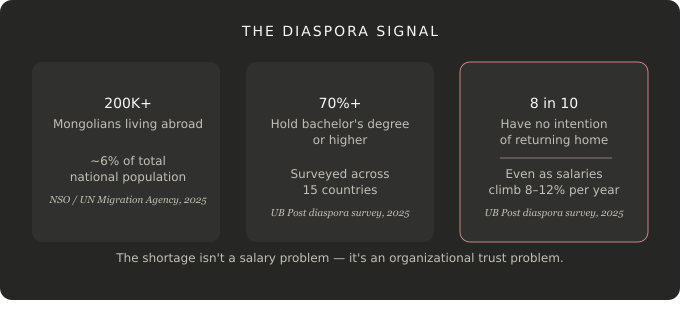
There is no shortage of Mongolian professionals working abroad. Engineers in Korea, finance professionals in Singapore, consultants in Australia. Estimates put the Mongolian diaspora at well over 200,000 people worldwide—around 6 percent of the country’s entire population. According to a recent survey of Mongolians living across 15 countries, more than 70 percent of them hold a bachelor’s, master’s, or doctoral degree. Yet eight out of ten said they had no intention of returning to their homeland.
That is often misunderstood as a salary problem. It rarely is. People do return—but only for roles that feel worth returning to. That means clear mandates, real authority, and organizations that operate with a certain seriousness. When those conditions are absent, the global market stays more attractive, even if the pay gap narrows. The shortage of diaspora talent in senior roles isn’t the root cause. It’s a reflection.
At the executive level, hiring in Mongolia still leans heavily on familiarity. The professional network in Ulaanbaatar is small. Most searches begin with a shortlist that already looks nearly identical across firms. For a while, that works. Then it starts to show its limits. The same people are approached over and over. They become harder to reach, more selective, and predictably more expensive. Hiring timelines stretch. Expectations on both sides drift apart. Offers get pushed higher not because the role demands it, but just to keep the conversation alive.
It feels like a tight market. In many ways, it is artificially tight—because the search stays too narrow for too long.
That’s where Lambda.Global starts to matter. Not as a shortcut, but as a way to make the market more visible. Real compensation benchmarks that show what similar roles actually pay—not just the inflated figure a desperate company slapped on at the last minute. Access to professionals who don’t surface in the usual Ulaanbaatar network, including Mongolians abroad who might be open to the right conversation. It doesn’t magically fix hiring. It removes a layer of guesswork that companies have operated with for years.
The cost of waiting until it’s urgent
Most companies only think seriously about leadership when something breaks. A key person leaves. A role opens. Suddenly it’s urgent. By then, choices are limited and expensive. The companies that navigate this better do something less dramatic. They spot people early, give them room to grow, and treat leadership development as part of running the business—not a panic button for when a gap appears. It’s quiet work. It doesn’t look impressive from the outside. But when a role opens, they aren’t scrambling.
The gap will not close on its own
Mongolia’s economy is still moving towards a positive direction. The World Bank projects 5.0 percent growth for Mongolian economy in 2026. Therefore, demand for experienced leadership will only increase in the future. Supply will take much longer. That gap isn’t going to fix itself.
Sooner or later, companies will need to stop treating hiring as a response or leverage, and start treating it as recruiting a talent you build over time. That means clearer development paths, leaders who take people seriously, and better data. Compensation visibility, a wider view of the talent pool, and genuine access to diaspora professionals aren’t “nice to have” anymore. They’re part of how modern hiring gets done.
Right now, most organizations are still reacting. The few that stop reacting first will be in a very different position five years from now.
Conclusion
Mongolia isn’t losing because it lacks talent. It’s losing because it hasn’t fully connected that talent to the right opportunities. Rising salaries have made the gap more visible. They haven’t closed it. The companies that will shape the next phase of Mongolia’s economy aren’t the ones offering the highest pay. They’re the ones building leaders before they urgently need them—and using the right tools to see the full market before making their most critical decisions.
Everyone else will keep searching.
References
- Rivermate, Recruitment in Mongolia (2025) – typical hiring timelines for professional roles.
- National Statistics Office of Mongolia / WageCentre – national average monthly salary, 2025.
- Higher Careers, Executive Compensation Trends in Mongolia 2025 – executive base salary movement.
- World Bank, Mongolia’s Economy Stays Resilient but Faces Rising Uncertainty (April 2026) – GDP figures and 2026 projection.
- CEIC Data, Mongolia Average Monthly Wage: Mining & Quarrying – Q4 2025 data.
- AmCham Mongolia, Salary Survey 2024 – IT sector average salary.
- Higher Careers, Career Paths for Senior Managers in Mongolia’s Key Industries – senior mining manager compensation range.
- National Statistics Office & United Nations Migration Agency – diaspora population estimate (via E-Mongolia, April 2025).
- UB Post, Should we continue letting talented minds flow outward? (May 2025) – diaspora education levels and return intention survey.
- MONTSAME, Mongolia’s Workforce Demand in 2025 to Reach 83.7 Thousand (Jan 2025).
- 9cv9 Blog, The State of Recruitment and Hiring in Mongolia in 2025 (April 2025) – recruitment landscape and talent shortage overview.