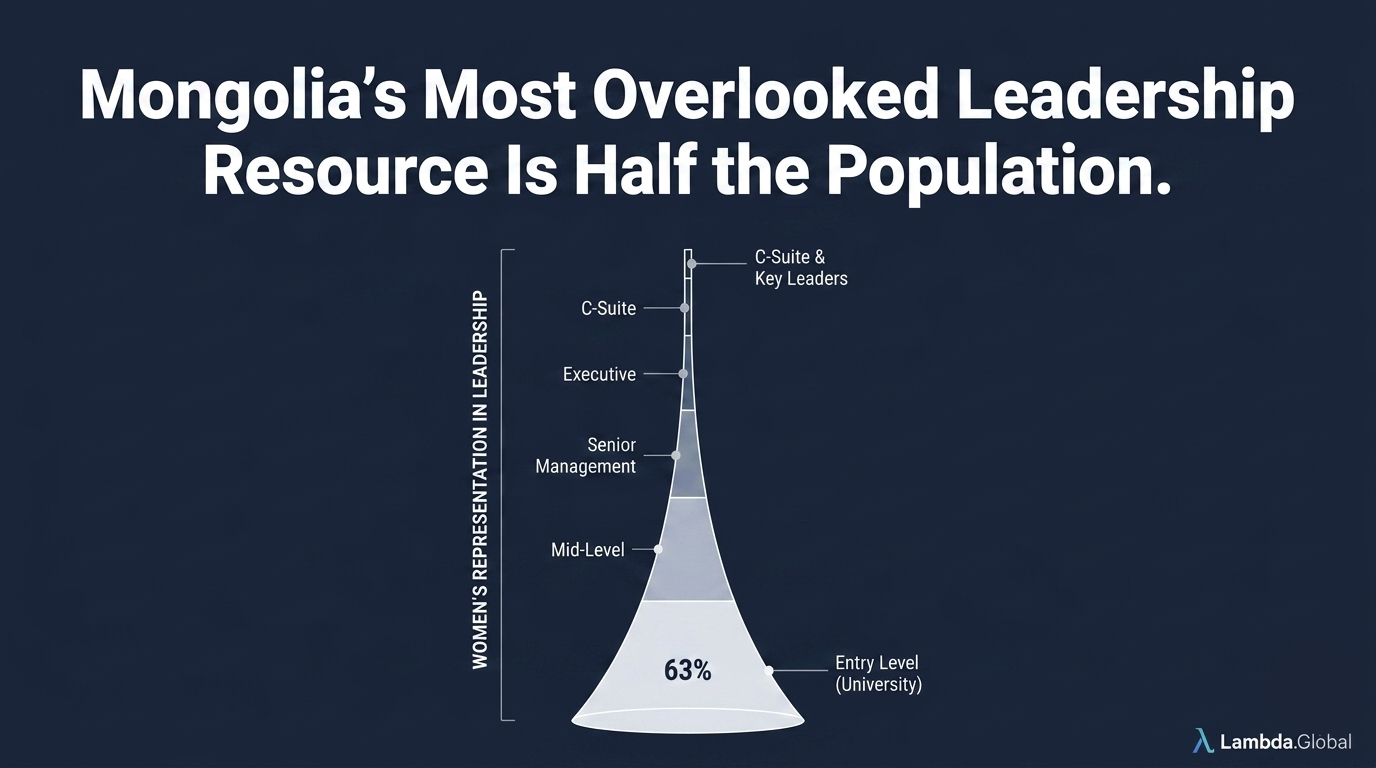
Mongolian women outperform men in education, dominate the professional workforce, and consistently demonstrate the qualities organizations say they want in leaders. Then they get passed over. Something is not adding up, and it is costing this country more than most executives want to admit.
Start with the numbers, because they are genuinely striking. According to the World Economic Forum’s 2024 Global Gender Gap Report, women make up 63% of Mongolia’s professional and technical workforce, the highest share in the entire Eastern Asia and Pacific region. Mongolian women consistently outperform men in tertiary education. They are present, qualified, and working. In any rational account of how talent pipelines are supposed to function, this should mean Mongolian women are well-represented at the senior leadership level.
They are not. Female executives earn between 10 and 18% less than men in equivalent roles. Overall, women’s average salary in Mongolia sits at 1.7 million MNT per month against men’s 2.3 million, a gap that widens, not narrows, as seniority increases. The boardrooms and C-suites of Ulaanbaatar’s largest organizations remain predominantly male, even though the professional class feeding into them is majority female. Mongolia has, in short, built an impressive system for developing female talent and a stubborn system for not deploying it.
63% of Mongolia’s professional & technical workers are women highest in the region (WEF 2024)
This is not a problem unique to Mongolia. Globally, women represent 43.4% of the total workforce but only 30.6% of leadership positions. Research consistently identifies what is now called the ‘broken rung,’ the first promotion to management, where for every 100 men elevated, only 81 women make the same move. That initial gap compounds at every subsequent level, which is why the drop from entry-level near-parity to C-suite underrepresentation is so dramatic worldwide.
But Mongolia’s version of this problem has a particular shape. It is not that Mongolian women lack professional presence or educational attainment; they have both in abundance. The gap is almost entirely concentrated in the transition from competent professional to recognized leader. And understanding why that transition stalls requires looking honestly at the mechanisms that govern it.
The Visibility Problem
Leadership in Mongolia’s corporate sector is still substantially assigned through relationship networks through connections, through visibility in the right rooms, through the informal credibility that accumulates when senior people notice you and remember you. This system, as we have explored in previous pieces, creates problems for everyone outside the dominant network. But it creates a specific and compounding problem for women.
Women in Mongolia’s professional class are, statistically, everywhere in banking operations, in finance departments, and in mid-level management across nearly every sector. What they are less present in are the informal spaces where senior visibility is built: the post-meeting conversations, the industry dinners, the golf rounds, and evening gatherings where professional credibility is traded alongside social currency. This is not a Mongolian idiosyncrasy. It is a universal dynamic. But in a market as small and relationship-dependent as Ulaanbaatar’s, its effects are amplified.
A senior woman at a major Mongolian bank described it this way in a recent interview: she had spent eight years being the most prepared person in every meeting she attended, and four years wondering why colleagues who were less prepared kept being asked to lead things she was not. The answer, when she eventually understood it, was not about preparation. It was about presence in spaces she had not prioritized and had not been explicitly invited into.
The ‘Not Yet Ready’ Deferral
One of the most consistent patterns in how Mongolian organizations discuss female leadership is the language of timing. Women are often described genuinely, not maliciously, as ‘almost ready,’ as ‘strong candidates for the next cycle,’ as professionals who would benefit from ‘a bit more experience before taking on that scope.’ This framing is so common that it has become almost invisible.
What makes it insidious is that it is often applied asymmetrically. Research from WEF’s 2025 Gender Gap Report confirms what many women in professional settings already know from experience: globally, women are hired and promoted on demonstrated performance, while men are more frequently elevated on perceived potential. The result is a structural double standard embedded in ordinary language, women have to prove readiness while men are assumed to have it.
In Mongolia’s executive hiring market, this plays out in a specific and measurable way. When Lambda. Global and other executive search firms map the available candidate pool for senior roles, and the qualified female candidates are consistently there. The gap is not in the pipeline. It is in which candidates’ organizations approach first, which ones they describe as ‘obvious fits,’ and which ones they require to clear additional informal bars before being considered seriously.
18% executive pay gap between equivalent male and female roles in Mongolia (Higher Careers 2025)
What Is Actually Changing
The picture is not static, and it would be misleading to present it as though nothing is moving. Mongolia’s 2024 parliamentary elections were a genuine milestone: women now hold 25.4% of parliamentary seats, an 8-percentage-point increase in a single election cycle, pushing Mongolia above the Asian average for female political representation for the first time. Gender quotas for Parliament are legislated to rise to 30% and then 40% by 2028. These are structural interventions, and they are producing structural results.
Mongolia also narrowed its overall gender gap by more than 2 percentage points between 2024 and 2025, according to WEF, one of the larger improvements globally in that period. The direction is right. The pace is the question.
In the private sector, movement is slower but present. Mongolia’s most internationally integrated companies, particularly those with foreign joint venture partners, international board representation, or direct exposure to global governance standards, are measurably further ahead on female leadership representation than domestically focused organizations. This pattern mirrors what research shows globally: external accountability pressure is one of the most reliable accelerators of internal gender equity progress.
The Business Case That Should Not Need Making
There is a version of this conversation that appeals entirely to economic logic, and it is worth stating plainly even if it should not be the primary argument. Companies with greater gender diversity in leadership demonstrate higher profitability, stronger governance outcomes, and better talent retention. WEF’s research is explicit that organizations with women in top management are more likely to hire women into those roles going forward, meaning the compounding effect works in both directions. Mongolia’s economy is growing at 6.5% and faces a projected shortage of 240,000 workers by 2035. In that context, systematically underutilizing half the talent pool is not just an equity failure. It is a strategic one.
But the economic case, compelling as it is, should not be the only lens. The women being passed over for leadership roles they have earned are not primarily a resource being wasted. They are professionals whose contributions are being undervalued in a market that loudly claims to be desperate for talent. The contradiction sits in plain sight.
What Needs to Happen
Three things, specifically, would make a measurable difference in Mongolia’s corporate sector within a hiring cycle or two.
First: structured succession planning that explicitly maps female candidates into future leadership roles, not as a quota exercise but as an acknowledgment that the existing network-based system consistently produces a skewed result. If your senior leadership pipeline contains few women, the problem is not the pipeline. It is the process of generating it.
Second: deliberate sponsorship, not just mentorship. Mongolia’s professional women have mentors. What they frequently lack is sponsors, senior leaders who actively advocate for them in rooms they are not yet in, who attach their own credibility to a junior woman’s readiness for the next level. Mentorship helps people develop. Sponsorship is what actually moves careers.
Third, and most directly: organizations need to examine the language they use when evaluating female candidates for senior roles. ‘Almost ready’ applied to a woman who would be considered ready if she were a man is not neutral language. It is a decision. And in a country running out of time to develop its leadership bench, it is a decision with consequences that compound.
Mongolia has spent decades building a professional class that is majority female at the technical and mid-level tiers. The question now is whether it is willing to let that investment pay off or whether it will keep the returns on the wrong side of the ledger.
SOURCES & REFERENCES
1. WEF — Global Gender Gap Report 2024
Women = 63% of Mongolia’s professional/technical workforce (highest in Eastern Asia & Pacific); regional leadership share comparisons.
https://www.weforum.org/publications/global-gender-gap-report-2024
2. WEF — Global Gender Gap Report 2025
Mongolia narrowed gender gap 2+ percentage points 2024–2025; women hired on performance vs men on potential; broken rung data.
https://www.weforum.org/publications/global-gender-gap-report-2025
3. UNDP Mongolia — Breaking Barriers of Women’s Leadership (April 2025)
Women hold 25.4% of parliamentary seats post-2024 elections (+8%); gender quota legislation rising to 30% then 40% by 2028.
4. Higher Careers Mongolia — Executive Compensation Trends 2025
10–18% executive pay gap between male and female equivalents; women avg 1.7M MNT vs men’s 2.3M MNT.
https://www.higher.careers/blog/2025/10/executive-compensation-trends-mongolia-2025
5. High5Test — Women in Leadership Statistics 2024/2025
Global broken rung data: 81 women promoted per 100 men; 48% entry-level to 29% C-suite attrition pipeline; 11% Fortune 500 female CEOs.