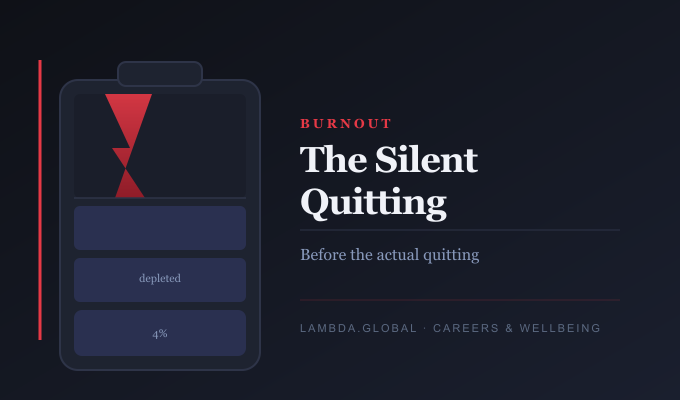
Everyone can recognize this path to success. The employee gets promoted, the salary jumps and the title is elevated. But the hours start to stretch and the phone calls never stop. One day, someone asks how you are doing and you realize you have been burnt-out for a long time. Burnout isn’t a crisis that arrives suddenly. It’s a slow fade and by the time most people notice that they are burnt-out, they have already been running on empty fuel.
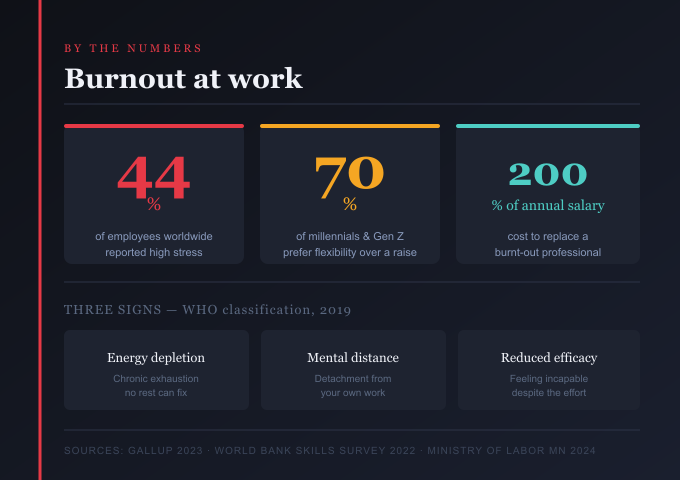
The term burnout doesn’t have much appeal. It seems too serious, too remote for ordinary people and seems like something that only happens to other people in other countries. But figures speak a different language. According to a Gallup survey conducted in 2023 across various locations, 44% of employees worldwide expressed feelings of experiencing a lot of stress on the previous day. In East Asia, the figure remains above average. Statistics specific to Mongolia aren’t as plentiful regarding this issue, but the same trends are visible for anybody who works in the corporate environment of Ulaanbaatar city.
The problem is that burnout does not announce itself. It accumulates with one missed dinner with family, one weekend spent catching up on emails, and one more week of pushing through the work without a break. As a consequence, the most reliable employee on the team starts showing up late, making uncharacteristic mistakes and mentally checking out.
The World Health Organization recognized burnout as an occupational phenomenon in 2019 and the following are its criteria:
- Feelings of energy depletion
- Increased mental distance from one’s job
- Reduced professional efficacy
You do not need a medical degree to notice how many people fit that description.
In Mongolia, what causes the burnout is common enough but quite focused. The city traffic alone will swallow two to three hours of a person’s life before reaching their workplace. Visibility at the workplace is still paramount, despite having options for working remotely in such sectors. Living costs are rising in a rate that frightens the average family. As a result, employees are left no choice but to cling on to jobs they could otherwise abandon.
According to a 2024 study by the Ministry of Labor and Social Protection, one of the main issues stated by young professionals as one of the main causes of them leaving a job was overworking and a lack of flexibility. Another interesting finding of that research showed that 70% of Millennials and Gen Z employees preferred having flexibility rather than a moderate raise in wages at work. Unfortunately, organizations have not managed to adapt to their needs yet.
What actually helps, according to people who study this
Autonomy is the strongest protection. If people can decide how, when, and in what sequence they perform their tasks, they will be much less susceptible to exhaustion. However, this does not imply anarchy. Autonomy means that one gives professionals freedom to manage their schedule and productivity independently. The shift from a culture that respects supervision is difficult in a society that places great importance on supervision. However, such organizations see improved retention and motivation rates.
The second thing is appropriate limits for workload. A team that sends e-mails at 11 pm is quietly signaling that everyone needs to be ready at 11 pm to check their email. The most straightforward and least expensive way to prevent burnout on your team is a clear understanding that anyone who emails before 7 pm isn’t required to answer anything non-urgent.
The third way is through professional development. When one feels they are developing, then the same small stresses become much more bearable. The findings of the 2022 skills survey by the World Bank in Mongolia indicated that employees who enjoyed training and learning regularly felt more satisfied and were less inclined to move out of their position. Development doesn’t always need to cost money. It could just be mentoring, challenging tasks, or access to quick classes.
Ignoring burnout costs more than addressing it
Burnout is often treated as a soft issue where the HR team can worry about between budget meeting, but the financial cost is hard. Depending on their role, replacing a mid-level professional costs between 50% and 200% of their annual salary. When a capable person burns out and walks away, the organization doesn’t just lose a body. They lose institutional knowledge, relationships and months of productivity.
There is also a quieter cost. When the most dedicated employees burn out first, because they are the ones everyone piles work onto, the organization loses exactly the people it most wants to keep. This is a signal that the system is failing.
Where Lambda.Global fits
Lambda.Global contributes to this conversation by making market expectations more transparent. The sector reports and job data show which roles are demanding what, and increasingly, they show that candidates are prioritizing flexibility and work-life balance over salary alone. Companies that recognize this in their job design attract faster. Companies that do not find themselves searching longer.
Further still, the professional growth map provided by Lambda’s skill insights is one which will ensure engagement rather than stagnation. Engagement is not the opposition of burnout but an effective deterrent against it.
A closing thought
Burnout cannot be prevented by one policy alone. However, there are many small choices that can prevent it, such as a manager who does not send emails on Sundays, a professional who attends a training program because he finds it fascinating, and an organization that gauges commitment in terms of outcomes achieved.
The professionals who will be thriving in ten years are not the ones who pushed hardest, but the ones who learned that a career is a long game. And the organizations that will still have their best people are the ones that understood the same thing.
References
- Gallup, State of the Global Workplace Report (2023) – global stress and burnout statistics.
- World Health Organization, Burn-out an “occupational phenomenon”: International Classification of Diseases (2019).
- Ministry of Labour and Social Protection / Research Institute of Labour and Social Protection, Labor Market of Mongolia: Mid-Term Demand and Supply Forecasting Study Report (2024) – youth preferences for flexibility.
- World Bank, Skills demand in Mongolia: Main Findings of the Skills Module of the Barometer Survey (2022) – link between training and job satisfaction.
- Society for Human Resource Management, SHRM Research: The Cost of Employee Turnover (2022) – replacement cost ranges.
- Lambda.Global, Sector Salary and Skills Reports (2025) – observed candidate preferences and demand signals.