Somewhere between the ages of 30 and 40 when professionals reach their mid-career period, there is an unexpected onset of anxiety. The realization that the skills learned five years ago have advanced to version 7.0, the new employees use terminology that sounds foreign, and the job once thought secure does not seem so stable any more sneaks up on the worker one day while sitting at their desk.
This is not something particular to the local case. This happens all over the world. However, the situation becomes more critical in small markets such as Ulaanbaatar city, where the career opportunities may be limited and side tracks less available.
Degrees expire faster than we admit
A university degree used to be a ticket to a lasting career, but that is no longer true. The shelf life of technical knowledge is shrinking across every sector. A financial modelling approach that worked in 2020 is now automated. A marketing skill set built around Facebook ads is now only one piece of a vastly more complicated puzzle. The software you use today may be replaced within several months.
The World Bank’s 2022 skills survey in Mongolia found something telling. According to the survey, employers struggled the most with finding people who could solve problems without a script, communicate clearly across teams and keep learning after being hired. They didn’t say they struggled with finding people who had the right certificates. In fact, those three key qualities are rarely listed in job descriptions. They show up in the work itself.
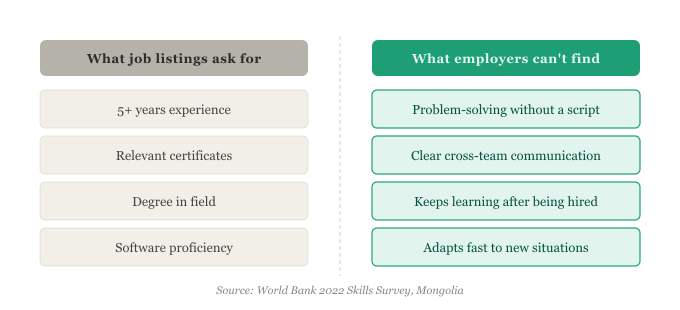
So if the most valuable qualities are the ones that cannot be stapled to a CV, how can one prove they have them?
Learning like it is a responsibility, not a side project
Although most professionals agree that continuous learning is important, barely anyone does it. The simple reason is that the learning gets squeezed into whatever is left at the end of the week and by then there is no energy left. However, the people who stay ahead treat learning as part of the job, not an addition to their responsibilities.
A practical starting point is to ask a question from yourself. If I had to apply for my own role today, what would make me a strong candidate? What would expose me? The answers point directly to where learning should happen. Maybe it is data analysis. Maybe it is working with AI tools instead of ignoring them. Maybe it is public speaking, or better written communication. The specific answer matters less than the honesty behind it.
There is no need to enroll in a two-year master’s program. Small, consistent actions work with a short online course in a relevant tool, a month spent reading everything credible about a new trend in your industry and a deliberate effort to take on a project at work that forces you outside your comfort zone. Over a year, those small actions will compound. Over three years, they separate the people who are still advancing from the people who are just holding on.
Why the local market rewards adaptability
Mongolia’s private sector is not static. Logistics companies are becoming more sophisticated. Professional service firms are competing for regional work. They need people who can figure out how things should be done now, not someone who only knows how things were done in 2019.
This is a genuine advantage for professionals who are willing to be uncomfortable. While a traditional resume might list years of experience and a series of well-known company names in the same sector, the thing that makes an employer lean forward in a conversation is evidence of adaptability. A story about learning something new and applying it fast. These things do not require a senior title. They require a mindset.
Where Lambda.Global becomes relevant
Lambda.Global is not only a hiring platform, but also a source of market intelligence for professionals who want to understand what the economy demands. Through the salary and skills reports, Lambda can show which roles are growing, which skills are becoming more requested, and where the gaps between supply and demand are widening.
In the case of someone looking at their future career, this kind of knowledge will prove to be far more useful than any generic career advice. This knowledge will not only tell us what we are supposed to value according to what people claim, but also what our employers consider valuable and relevant at the moment. Being employable does not imply knowing everything, but knowing what others do not yet know.
Endnote
No one is coming to protect your career. That may sound harsh, but it is also freeing. It means the decisions you make about what you learn and how you grow are completely yours. There will be no bureaucracy, no manager, no company policy that can take that away.
In 2026, the safest professional in Ulaanbaatar city is not the one with the highest title or the largest network. It is the one who can walk into a new situation, admit what they do not know and start figuring it out faster than anyone expected.
That skill will never appear on a CV. It is also the one thing that will keep you employed for as long as you want to be.
References
- World Bank, Skills demand in Mongolia: Main Findings of the Skills Module of the Barometer Survey (2022) – employer valuation of soft skills and learning agility.
- Lambda.Global, Sector Salary Reports (2025) – data on emerging skill demands across industries in Mongolia.
- LinkedIn Learning, Workplace Learning Report (2024) – global trends on skill shelf life and continuous learning habits.