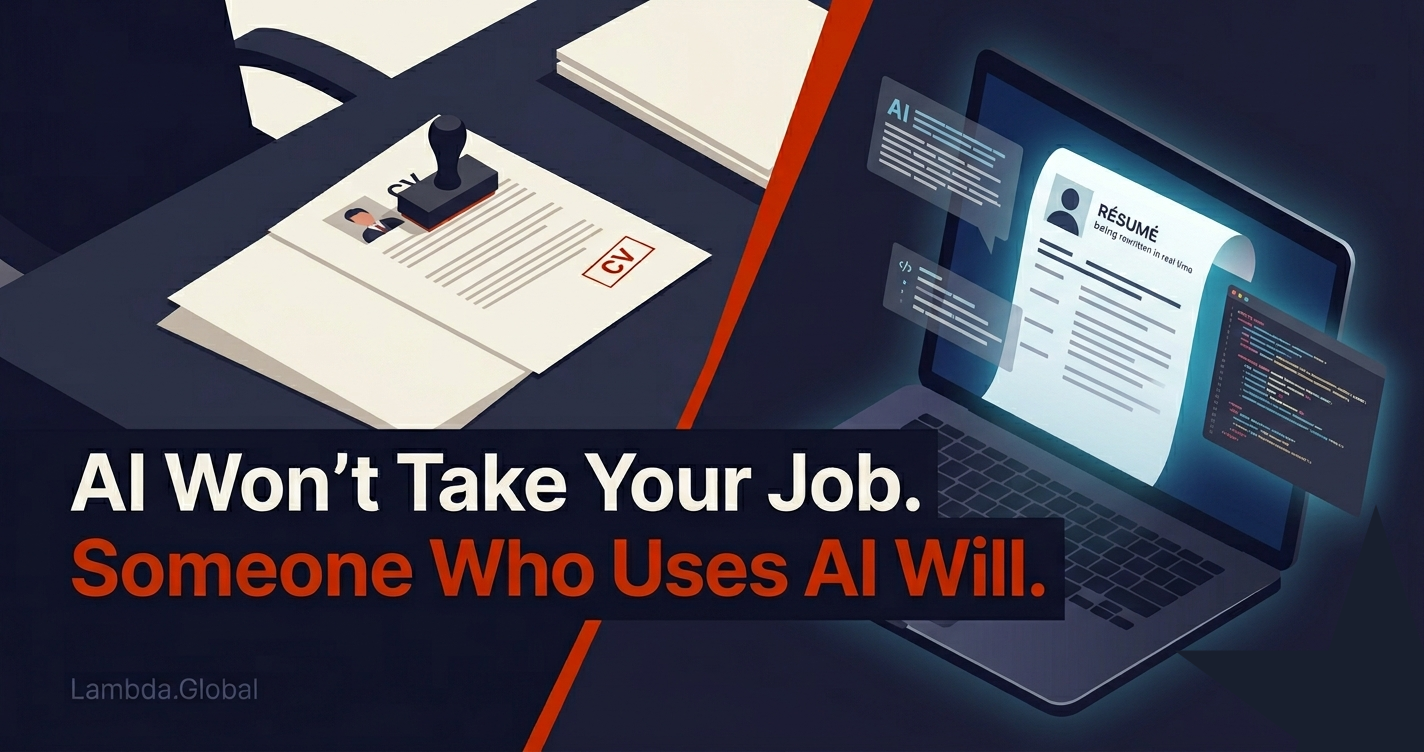
Picture a hiring manager at a mid-sized Mongolian company. She has just posted a vacancy. Within 48 hours, 200 CVs land in her inbox. Except they didn’t come from 200 candidates. Most of them came from maybe 40 people who used AI to tailor each application to the specific job description, making everyone look like a perfect fit.
This is where AI and hiring intersect in 2026, not in some distant future of robots doing interviews, but in small, practical, daily decisions that are quietly reshaping who gets seen, who gets hired, and who gets left behind. Mongolia is not immune. If anything, the country’s small talent market makes the stakes higher.
What’s Actually Happening Right Now
Three shifts are happening simultaneously, and they are moving faster than most HR teams in Ulaanbaatar realize.
First: Candidates are using AI aggressively. ChatGPT, Claude, and a growing list of specialized tools can rewrite a CV in minutes, draft cover letters that mirror a company’s own language back at them, and coach applicants through interview prep with unsettling accuracy. Globally, the use of AI tools in job applications jumped 68% between 2023 and 2024. The same tools are available to anyone in Mongolia with a smartphone and a Wi-Fi connection. They are being used just unevenly.
Second: Employers are adopting AI screening tools, but slowly and patchily. Globally, 87% of companies now use some form of AI in hiring. In Mongolia, adoption is real but uneven. Larger multinationals and mining operations with international HR standards are further ahead; local SMEs and state-adjacent organizations are largely still screening manually. The result is a divided hiring landscape where some candidates are filtered by algorithms before a human ever sees their name, while others are still relying on printed CVs sitting in stacks on someone’s desk.
Third: This is the one most people miss. AI is changing what skills are actually worth hiring for. The shelf life of a technical skill in 2026 is shorter than it has ever been. Data entry, basic financial modeling, and standard report writing are not disappearing overnight, but they are depreciating. The skills becoming more valuable are the ones AI cannot easily replicate including judgment under pressure, the ability to turn data into decisions real organizations will actually act on, and in Mongolia’s relationship driven business culture the kind of trust built through shared experience and proven integrity.
If You’re the One Hiring
The immediate practical problem is signal collapse. When AI tools can make any candidate look compelling on paper, the CV becomes a less reliable filter than it already was. This is uncomfortable news for hiring teams that have always leaned on CV screening as the first gate, and in Mongolia, where formal hiring processes are still maturing across many organizations, the first gate is often the only gate.
The response isn’t to dismiss CVs, it’s to move the real evaluation earlier and make it harder to fake. Structured first-round calls with specific scenario questions. Short practical assignments that reveal how someone actually thinks, not how well they can prompt an AI to describe their thinking. Reference conversations that go beyond “was this person employed here” and into what they were genuinely like under pressure.
None of this is revolutionary. But in a market like Mongolia’s, where hiring timelines are often rushed, personal relationships substitute for process, and many companies simply do not have the internal HR infrastructure to run rigorous evaluations, the gap between companies that do this well and those that don’t is widening fast.
If You’re the One Looking for a Job
Here is the honest version of the AI and jobs conversation that most career advisors avoid: the threat is not that AI replaces your role. The threat is that someone in your field who uses AI competently outcompetes you for it.
A financial analyst who uses AI to run scenario models in two hours instead of two days does not just do their job faster. They become a different kind of candidate, one who can take on a broader scope, engage at a more strategic level, and make a more compelling case for a senior role earlier in their career. That gap is already visible in how Mongolian fintech companies like LendMN and AND Global are evaluating talent: they are not just asking what you know, they are watching what you can produce with the tools available to you.
The Mongolian professionals who will be most exposed over the next five years are not those in technical roles who sound vulnerable, such as coders, analysts, and junior accountants. It is the people in mid-level roles whose value proposition has always been “I know how things work here” without continuing to build new capabilities on top of that local knowledge. Institutional memory is valuable. Institutional memory plus the ability to work faster and smarter than a year ago is irreplaceable.
The Part That’s Specific to Mongolia
Mongolia’s professional culture has always placed enormous weight on relationships, on who you know, on shared institutional history, on the trust that comes from years of working alongside someone. That is not going away, and AI cannot replicate it. In fact, as AI homogenizes the surface layer of hiring, making CVs look more similar, making first interviews more polished, the differentiation shifts further toward the things that cannot be faked, such as reputation, judgment, and the specific credibility that comes from having done hard things in a small community where everyone notices.
This is both a comfort and a warning. A comfort, because the core of what makes Mongolian professionals valuable in their own market contextual intelligence, relationship capital, and cultural fluency, is not being automated. A warning, because that advantage only holds if it sits on top of genuine skill development, not instead of it.
At Lambda.Global, the patterns we see in executive and mid-senior hiring confirm this. The candidates who generate the most interest right now are not the most credentialed or the most connected; they are the ones who combine local credibility with demonstrable adaptability. Employers want proof that someone can learn, not just a resume that proves they once did.
The conclusion
AI is not the disruption. The disruption is the uneven adoption of AI across companies, across candidates, across industries. In any market where some players adapt, and others don’t, the gap compounds quickly.
Mongolia’s hiring market is small enough that those gaps will become visible faster than most people expect. Which side of the gap any given professional or organization ends up on is, for now, still a choice.